Bronze has been the material of choice for sculpture and public art for thousands of years. It’s durable, it weathers beautifully, it takes incredible detail, and when patinated correctly it has a warmth and depth that no other material matches. If you’re an artist, sculptor or architect in New Zealand considering bronze casting for your next project, this guide covers everything you need to know — from choosing the right casting method to understanding patination finishes — based on how we work here at Molten Manufacturing in Glendene, Auckland.
Which Bronze Alloy Is Used for Sculpture?
Not all bronze is the same. For artwork and sculpture, the standard alloy at Molten Manufacturing is C87300 silicon bronze. This is the preferred choice for gallery-quality work for several reasons:
- Excellent fluidity when poured — fills fine detail reliably
- Good weldability — essential when joining cast sections
- Takes patination beautifully — produces rich, consistent colour
- Long-term durability — proven in outdoor and indoor installations over decades
For marine applications such as propellers, we use AB2 propeller grade bronze — a very different alloy with different mechanical properties. If you’re commissioning artwork for outdoor installation near the coast, it’s worth discussing alloy selection with us.
Which Casting Method Is Best for Bronze Sculpture?
Investment Casting (Lost Wax)
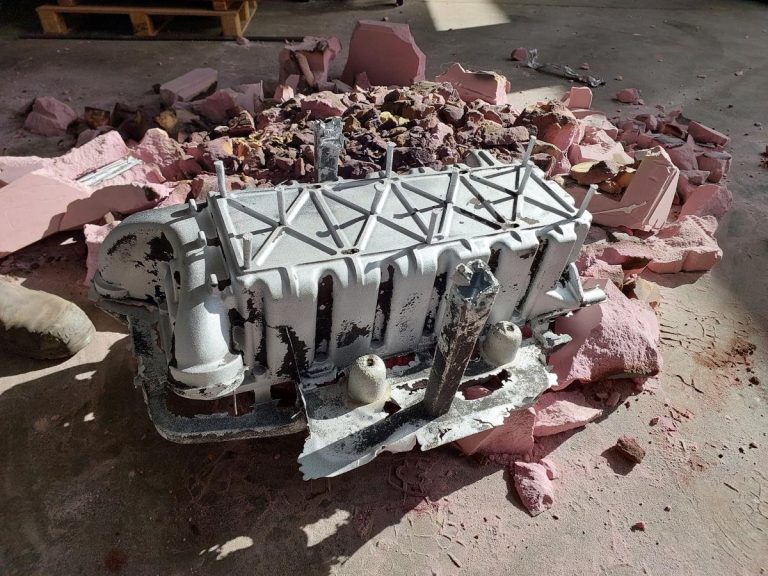
Investment casting is the traditional choice for gallery-quality bronze sculpture. The process starts with a wax pattern, which is built up with a ceramic shell over approximately four days of dipping. The shell is fired to 1000°C, the wax is removed, and bronze is poured into the void.
For intricate work — fine facial features, thin organic forms, complex undercutting — investment casting is often the only method that will achieve the result you’re after. Minimal fettling is required after casting, which matters enormously on bespoke works where the surface is difficult to rework.
Hardsand Casting
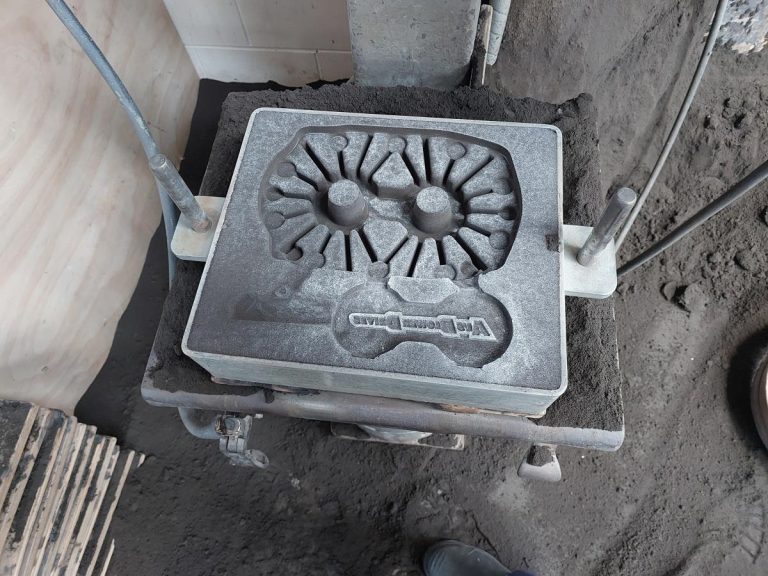
For larger bronze works, hardsand casting is often the better choice. A proprietary refractory paint applied to the hardsand mould can produce a surface finish rivalling investment casting, at a fraction of the cost and without the time-consuming ceramic shell build.
Hardsand is also ideal when working from an existing three-dimensional object — a clay marquette, a carved original or an existing casting that needs reproducing. Molten Manufacturing can take your original through hardsand in a way that keeps the original completely intact and unmarked.
Which should you choose?
For small-to-medium intricate works where fine surface detail matters — investment casting. For larger works, panels or architectural elements where cost is a factor — hardsand with refractory paint. In some cases, combining both methods on different panels of a large work is the most practical approach.
The Complete Art Department at Molten Manufacturing
What sets Molten Manufacturing apart from most NZ foundries is a complete art department — the capability to take a project from raw idea or marquette all the way through to a finished, installed, patinated bronze work.
Mould Making Depending on size and complexity, mould making uses silicone rubber in block form for smaller works, glass-backed silicone rubber for medium works, and urethane brushable rubber with glass backing for larger pieces.
Wax Working Molten Manufacturing uses its own blend of waxes formulated for gallery-quality bronze — accounting for shrinkage, fusibility, detail reproduction and firmness. Every wax goes through a refinement process before ceramic shell dipping. Details are chased and corrected in wax — always easier to fix before it’s set in metal.
Patination A large range of patination finishes is available — from rich liver-of-sulphur browns and blacks through to verdant greens and custom blended finishes. Samples are provided where appropriate. Finishes are designed for longevity, particularly for outdoor installation.
Installation and Maintenance Structural armatures can be manufactured onsite to design. Installation and ongoing maintenance services are also offered — making Molten Manufacturing a true end-to-end partner for artists and public art commissioners.
What to Expect Working with a Foundry as an Artist
Many artists come to us with nothing more than a clay model, a sketch or a reference image. Here’s what the process typically looks like:
- Initial conversation — bring your idea, marquette or reference. We discuss method, timeline and cost.
- Mould making — a rubber mould is made from your original if needed.
- Wax production — waxes are produced, chased and refined by the art department team.
- Casting — investment or hardsand casting in your chosen alloy.
- Fettling and welding — cast sections are welded and fettled to gallery standard.
- Patination — your chosen finish is applied by our skilled artisans.
- Installation — armatures made and work installed if required.
Shaun prefers a conversation to an email. Call 022 088 2040 and describe what you’re working on — or send an enquiry.
Bronze Casting Auckland — Talk to Molten Manufacturing
If you’re an artist, sculptor or architect looking for bronze casting Auckland professionals can trust, Molten Manufacturing is Auckland’s only full-service foundry offering complete end-to-end capability — from concept through to installed, patinated work.
Call 022 088 2040 or get in touch here.