Restoring a classic vehicle in New Zealand often hits the same wall — the part you need is no longer manufactured, the overseas supplier wants three months and a small fortune, or what’s available simply isn’t to the standard the build deserves. Metal casting is often the solution, and it’s one that New Zealand’s automotive restoration community has been quietly relying on for decades.
At Molten Manufacturing in Glendene, Auckland, we produce a wide range of automotive castings — from engine blocks and bell housings to badges, grills, hood ornaments and sumps — for restorers, performance builders and collectors across New Zealand.
What Automotive Parts Can Be Cast?
If it’s a metal component on a vehicle, there’s a good chance we can cast it. Common requests include:
Engine Components
- Blocks and heads (aluminium)
- Bell housings
- Intake and exhaust manifolds
- Turbo housings
- Sumps and oil pans
- Water pump housings
Drivetrain and Running Gear
- Differential housings
- Gearbox casings
- Mounting hubs and brackets
- Bushes and bearings
Body and Trim
- Badges (aluminium and bronze)
- Grills and grill bars
- Hood ornaments and mascots
- Rim centres
Each can be produced from an existing part, from drawings, or using our 3D scanning and reverse engineering capability.
What If the Original Part No Longer Exists?
This is where scanning and reverse engineering becomes invaluable. If you have a damaged or incomplete original, we can:
- 3D scan the surviving portion and reconstruct missing sections digitally
- Apply contraction allowance and machine allowance before producing a pattern
- Cast a faithful reproduction in the correct alloy
Even if you only have a photograph, a workshop manual drawing or another vehicle with a similar part, there are often paths forward that experienced foundry people can identify. A conversation with Shaun is almost always the best starting point.
Which Casting Method Is Used for Automotive Parts?
Greensand for Production Volumes For parts where you need multiples — a run of aluminium rocker covers for a club restoration project, or repeat production of a bracket — greensand is the most cost-effective method. Once the pattern is made, subsequent runs are fast and affordable.
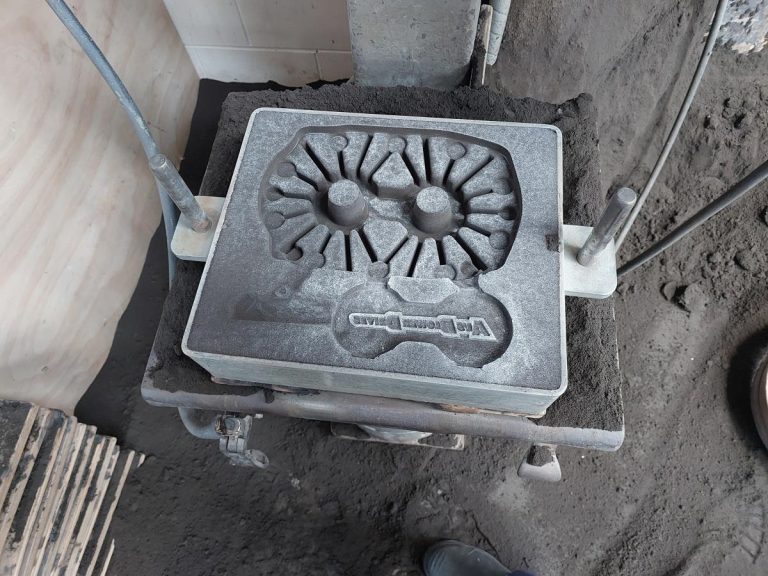
Hardsand for Complex Geometry For engine blocks, manifolds and bell housings, hardsand casting is usually the right method. It handles internal complexity through coring, allows minor undercuts, and can produce very large parts. It’s also the method used when an existing physical part is the pattern.
Investment for Detail Trim Work For badges, mascots and hood ornaments where fine surface detail matters, investment casting (lost wax) is often the best choice — reproducing lettering, fine relief and complex three-dimensional forms faithfully with minimal finishing.
Which Alloys Are Used for Automotive Casting?
- Aluminium LM4, LM6, CC601 — engine components, housings, brackets. CC601 is heat treatable for higher strength.
- Aluminium 5008 marine grade — components exposed to water or salt air
- Silicon bronze C87300 — badges, trim and ornamental components
- Grey iron — where weight, vibration damping and wear resistance are priorities
- Phosphor bronze — bushes, bearings and wear surfaces
Not sure which alloy is right for your application? Our metallurgist is available to advise.
Machine Allowance and Heat Treating
For any automotive casting that will be machined after casting — cylinder heads, blocks, manifold faces — machine allowance must be built into the pattern at the patternmaking stage. If heat treating is specified (common for high-load or competition components), this can be arranged with a certified report.
Automotive Casting New Zealand — One-Off or Production Run
One of the most common misconceptions about metal casting is that it’s only viable for large quantities. At Molten Manufacturing we handle everything from a single one-off prototype through to ongoing production supply. One bell housing for a personal restoration — we can do that. Repeat supply to a specialist workshop — we can do that too.
Automotive casting in New Zealand doesn’t have to mean long waits and expensive imports. Call Shaun on 022 088 2040 and describe what you’re working on — you might be surprised at what’s possible.
Get in touch here — Shaun prefers a conversation and will give you a straight answer on what’s possible and what it will cost.